Art of the Yao People Government of the Yao People
| 瑶族 | |
|---|---|
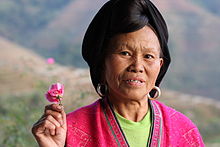 A Yao woman, Tiantouzhai, Longji Terraces, Red china, Nov 2010 | |
| Full population | |
| 3,500,000 + | |
| Regions with significant populations | |
 China: two,637,421 (2000) China: two,637,421 (2000) Vietnam: 891,151 (2019)[1] Vietnam: 891,151 (2019)[1] | |
| Languages | |
| Mienic languages, Bunu, Pa-Hng, Lakkja, Standard mandarin Chinese, Shaozhou Tuhua, Vietnamese, English | |
| Religion | |
| Predominantly Yao folk religion, minority Buddhism |
| Yao people | |||||||||||||||||||||||||||||||||
|---|---|---|---|---|---|---|---|---|---|---|---|---|---|---|---|---|---|---|---|---|---|---|---|---|---|---|---|---|---|---|---|---|---|
| Chinese | 瑶族 | ||||||||||||||||||||||||||||||||
| |||||||||||||||||||||||||||||||||
The Yao people (its majority branch is as well known equally Mien; simplified Chinese: 瑶族; traditional Chinese: 瑤族; pinyin: Yáozú ; Vietnamese: người Dao) is a government classification for various minorities in Communist china and Vietnam. They are one of the 55 officially recognised ethnic minorities in China and reside in the mountainous terrain of the southwest and south. They also form one of the 54 ethnic groups officially recognised by Vietnam. In Prc in the last census in 2000, they numbered 2,637,421 and in Vietnam census in 2019, they numbered 891,151.[1]
History [edit]
Early history [edit]
The origins of the Yao can be traced dorsum 2000 years starting in Hunan. The Yao and Hmong were among the rebels during the Miao Rebellions against the Ming dynasty. As the Han Chinese expanded into Due south China, the Yao retreated into the highlands betwixt Hunan and Guizhou to the north and Guangdong and Guangxi to the southward, and stretching into Eastern Yunnan.[2] Around 1890, the Guangdong government started taking action confronting Yao in Northwestern Guangdong.[3]
The first Chinese exonym for "Yao people" was the graphic debasing yao 猺 (犭"canis familiaris radical" and yao 䍃 phonetic) "jackal", with twentieth-century reforms this was changed to yao: "precious jade".
Laotian Civil War [edit]
During the Laotian Ceremonious State of war, the Yao tribes of Lao people's democratic republic had a good human relationship with U.S. forces and were dubbed to exist an "efficient friendly force". They fought in favour of the (South Vietnamese) government against the communists.[4] This relationship caused the new communist Laotian government to target Yao tribal groups for revenge in one case the war was over. This triggered farther clearing into Thailand, where the tribes would be put into camps along the Thailand-Lao people's democratic republic edge.
Clearing to the United States [edit]
Afterward obtaining refugee condition from the Thai regime and with the help of the United Nations, many Yao people were able to obtain sponsorship into the United States (although many remain in Thailand). About of the Yao who have immigrated to the Us take settled along the Western part of the U.S., mainly in Central and Northern California such as Visalia, Oakland, Oroville, Redding, Richmond, Sacramento, but as well in parts of Oregon like Portland, Salem, and Beaverton besides as the state of Washington in Seattle and Renton. See Mien American for those identified equally Mien.
Culture, social club, and economy [edit]

A Yao kid with traditional dress in Guangxi

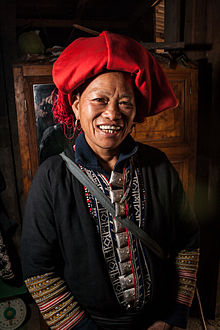
A red Yao woman in Vietnam
Yao club is traditionally patrilineal, with sons inheriting from their fathers. The Yao follow patrilocal residence.[5]
The Yao people accept been farmers for over a 1000 years, generally rice tillage through plowing, although a few practice slash-and-burn agriculture. Where the Yao live nearby forested regions, they also engage in hunting.[5]
During the Southern Vocal (1127–1279), an majestic Chinese observer, Zhou Qufei, described the Yao as wearing distinctive fine bluish clothing produced using indigo.[6]
The Yao celebrate their Pan Wang (Rex Pan) festival annually on the sixteenth day of the tenth lunar month. The festival celebrates the mythical original story of the Yao people, and has evolved "into a happy holiday for the Yao to gloat a expert harvest and worship their ancestors."[vii]
Religion [edit]
Daoism has historically been important to the Yao.[eight] Jinag Yingliang, in a 1948 study, argued that Yao organized religion was characterized past (1) a process of Han Chinese-influenced Daoisation (Chinese: 道教化; pinyin: Dàojiào huà ); (two) the endurance of pre-Daoist folk organized religion; and (3) some Buddhist beliefs.
The description of Yao faith is similar to the definition of Chinese folk faith as described by Arthur Wolf and Steve Sangren.[9] Scholar Zhang Youjun takes issue with claims of "strong Buddhist influence" on the Yao, arguing that "although Yao ritual texts contain Buddhist expression, the Yao do not believe in Buddhism at all. They are resolutely Taoist."[9]
Groups and languages [edit]

A Yao stilt firm in Vietnam
At that place are several distinct groups within the Yao nationality, and they speak several different languages, The Iu Mien comprise lxx% of the Yao population.[ citation needed ]
- Hmong–Mien languages
- The Mien speak Mienic languages (simplified Chinese: 勉语; traditional Chinese: 勉語; pinyin: Miǎnyǔ ), including:
- Mian–Jin languages
- Iu Mien, 2,172,000 speakers (1,699,750 in China, 350,000 in Vietnam, 40,000 in Thailand, xx,250 in Laos, 60,000 in the United States, two,000 in French republic) [1]
- Kim Mun (also known equally Lanten), more than than 300,000 Yao people [2]
- Biao Mon, twenty,000 speakers [3]
- Dzao Min, 60,000 speakers [iv]
- Biao Min, 43,000 speakers [5]
- Mian–Jin languages
- Hmongic languages
- Bunu languages
- Pa-Hng
- Younuo
- Kiong Nai
-
- Lakkja language (a Tai–Kadai language)
- Chinese
- almost 500,000 Yao speak Chinese dialects
In addition to China, Yao also alive in northern Vietnam (where they are chosen Dao), northern Laos, and Myanmar. In that location are around 60,000 Yao in northern Thailand, where they are 1 of the half-dozen main hill tribes. The lowland-living Lanten of Lao people's democratic republic, who speak Kim Mun, and the highland-living Iu Mien of Lao people's democratic republic are two different Yao groups. At that place are also many Iu Mien Americans, mainly refugees from the highlands of Laos. The Iu Mien do non call themselves "Yao". Not all "Yao" are Iu Mien. A group of 61,000 people on Hainan speak the Yao language Kim Mun; 139,000 speakers of Kim Mun live in other parts of Cathay (Yunnan and Guangxi), and 174,500 live in Lao people's democratic republic and Vietnam.[10]
The Bunu people call themselves Nuox [no13], Buod nuox [po43 no13], Dungb nuox [tuŋ33no13], or their official name Yaof zuf [ʑau21su21]. Only 258,000 of the 439,000 people categorised as Bunu in the 1982 census speak Bunu; 100,000 speak the Tai–Kadai Zhuang languages, and 181,000 speak Chinese and the Tai–Kadai Bouyei language.[ commendation needed ]
Mao (2004) [edit]
Mao Zongwu (2004:seven-8)[xi] gives a detailed list of various Yao endonyms (i.e., cocky-designated names) and the Chinese names of various groups and clans associated with them. Endonyms are written in the International Phonetic Alphabet with numerical Chao tones.
- Autonym mjen31 勉 or ju31 mjen31 优勉: Pangu Yao 盘古瑶, Pan Yao 盘瑶, Panhu Yao 盘瓠瑶, Trans-Mountain / Guoshan Yao 过山瑶, Large-Lath / Daban Yao 大板瑶, Modest-Board / Xiaoban Yao 小板瑶, Board / Ban Yao 板瑶, Top-Board / Dingban Yao 顶板瑶, Sharp-Headed / Jiantou Yao 尖头瑶, Level-Headed / Pingtou Yao 平头瑶, Ruby-Head / Hongtou Yao 红头瑶, Pointer-Pole / Jian'gan Yao 箭杆瑶, Cattle-Horn Yao / Niujiao 牛角瑶, Tu Yao 土瑶 (in Hezhou, Guangxi), Native / Bendi Yao 本地瑶, Flowery / Hua Yao 花瑶 (in Yangshuo County, Guangxi), Ao Yao 坳瑶, Zheng Yao 正瑶, Liang Yao 粮瑶
- Autonym kim33 mun33 金门 or kem53 di35 mun21 甘迪门: Bluish-Indigo / Landian Yao 蓝靛瑶, Shanzi Yao 山子瑶, Flowery-Headed / Huatou Yao 花头瑶, Sand / Sha Yao 沙瑶, Level-Headed / Pingtou Yao 平头瑶, Bazi Yao 坝子瑶
- Autonym bjau31 mɔn31 标曼 or ɕi31 mun31 史门: Min Yao 民瑶, "Iv Great" Min Yao 四大民瑶
- Autonym bjau31 min31 标敏 or tɕau44 koŋ55 meŋ55 交公勉: East Mount / Dongshan Yao 东山瑶 (in Quanzhou County, Guangxi), Canis familiaris-Headed / Goutou Yao 狗头瑶
- Autonym dzau53 min53 藻勉: Bapai Yao 八排瑶
- Autonym ju21 ŋjɛn25 优念, pjoŋ31 toa53 jeu31 炳多优, or ʂan33 tɕai33 珊介: Red Yao 红瑶 (in Longsheng Diverse Nationalities Autonomous County, Guangxi), Plains / Pingdi Yao 平地瑶
- Autonym pu53 nu25 布努: Beilou Yao 背篓瑶, Beilong Yao 背陇瑶, Westward Mount / Xishan Yao 西山瑶, E Mountain Yao / Dongshan 东山瑶 (in Bama Yao Democratic Canton, Guangxi), Tudi Yao 土地瑶, Tu Yao 土瑶 (in Pingguo County and Mashan County, Guangxi), Mountain / Shan Yao 山瑶, Man Yao 蛮瑶, Due east Valley / Dongnong Yao 东弄瑶, W Valley / Xinong Yao 西弄瑶, Fan Yao 反瑶, Anding Yao 安定瑶, White Yao 白瑶, Blackness Yao 黑瑶, Black-Trouser / Heiku Yao 黑裤瑶, Long-Shirt / Changshan Yao 长衫瑶
- Autonym nau35 klau42 瑙格劳 or pou22 nou12 包诺: Siting Yao 四亭瑶, Situan Yao 四团瑶
- Autonym kjɔŋ33 nai33 炯奈: Hualan Yao 花蓝瑶
- Autonym pa31 ŋ̊ŋ35 巴哼: Dog Yao 狗瑶, Viii-Surname / Baxing Yao 八姓瑶, Cherry-red Yao 红瑶 (in Liping and Congjiang Counties of Guizhou; Rongshui Miao Autonomous Canton and Longsheng Diverse Nationalities Autonomous County of Guangxi), Woods Yao 木瑶
- Autonym m̥n33 nai33 唔奈: Flowery Yao 花瑶 (in Longhui, Dongkou, Chenxi, and Xupu Canton and the Tongdao Dong Autonomous Canton of Hunan)
- Autonym ʑou13 nɔ13 优诺: Red Yao 红瑶
- Autonym lak25 kja25 拉珈: Tea Mount / Chashan Yao 茶山瑶
Plains Yao [edit]
Groups considered to exist "Plains Yao" (Pingdi Yao 平地瑶) include:[ citation needed ]
- Autonym Bingduoyou 炳多尤 (Pingdi Yao 平地瑶, Dainaijiang 代奈江): in Jianghua Yao Autonomous County 江华 of Hunan; Gongcheng 恭城, Fuchuan 富川, Zhongshan 钟山, and Lingui 临桂 counties of Guangxi
- Autonym Yeheni 爷贺尼 (Pingdi Yao 平地瑶): in Jianghua Yao Autonomous Canton 江华, Hunan (Jianghua Canton Gazetteer). The Yeheni speak a divergent Chinese dialect. It is spoken in Taoxu Town 涛圩镇 and Helukou Town 河路口镇 in Jianghua County, Hunan.[12]
- Autonym Younian 优念 (Pinghua-speaking Crimson Yao 平话红瑶; ʑou13 ȵen13 ): in Longsheng 龙胜 and Guanyang 灌阳 counties of Guangxi. According to Chen Qiguang (2013:30),[13] the ʑəu21 ȵien21 number about 10,000 speakers in Sishui 泗水, Madi 马堤, Mengshan 孟山, Jiangliu 江柳, and other locations of Longsheng Canton.
- Autonym Shanjie 珊介 (Shanzi Yao 山仔瑶): in Fangcheng 防城, Guangxi
- Autonym Youjia 优嘉 (Yaojia 瑶家): in Guanyang County 灌阳, Guangxi
- Jingdong Yao 景东县瑶族 (autonym: Lewu people 乐舞人): Jingdong Canton 景东彝族自治县, Yunnan. Co-ordinate to the Jingdong County Gazetteer (1994:519), indigenous Yao numbered 3,889 individuals in 1990, and lived mainly in Chaqing 岔箐[fourteen] and Dasongshu 大松树[xv] of Taizhong 太忠乡.
Vietnam [edit]
Tim Doling (2010:82-83) lists the following Yao (spelled Dao in the Vietnamese alphabet) subgroups in northern Vietnam.[xvi]
- Mienic groups
- Iu Mien: Blackness Dao of Dien Bien and Lai Chau; Red Dao of southern Lao Cai, Yen Bai, and Son La
- Kim Mien: Dao Tà Pán 大板瑶 (Dao Đại Bản, Dao Coóc Ngáng,[17] Dao Sừng[xviii]) of Ha Giang, Cao Bang, and Yen Bai; Red Dao of northern and eastern Lao Cai; Hongtou Crimson Dao 红头瑶 in northern Lai Chau
- Kiem Mien: Ruby-red Dao of Sa Pa
- Kam Mien: Coin Dao of Ha Giang, Cao Bang, Tuyen Quang, Thai Nguyen, and Bac Can
- Kem Mien: Coin Dao of Hoa Binh and Son La
- Quần Chẹt Mien: Hoa Binh, Son La, Tuyen Quang, Bac Can (also chosen the Dao Nga Hoàng, Dao Sơn Đầu[18])
- Lô Gang Mien: Dao Lô Gang and Dao Đầu Trọc of Ha Giang, Cao Blindside, Lang Son, and Mong Cai
- Kim Mun groups
- Kim Mun: Dao Làn Tiển 蓝靛瑶 (including the Dao Tuyển, Dao Áo Dài, and Dao Đầu Bằng)
- Kim Meun: Dao Quần Trắng 白裤瑶 and Dao Thanh Y 青衣瑶
According to Doling (2010), simply Kim Mun, Kim Mien, and Lô Gang may be found outside Vietnam.
Nguyen (2004:14-15, 128) lists Đại Bản, Tiểu Bản, Khố Bạch, and Làn Tiẻn as the 4 primary subdivisions of ethnic Yao in Vietnam.[xix]
- Đại Bản
- Dao Đỏ (Hùng Thầu Dào, Dao Coóc Ngáng, Dao Quý Lâm): located in Yen Bai, Lao Cai, Lai Chau, Tuyen Quang, Ha Giang, Cao Blindside, Bac Kan, Thai Nguyen
- Dao Quần Chẹt (Dao Sơn Đầu, Dao Tam Đảo, Dao Nga Hoàng): located in Hoa Binh, Ha Tay, Phu Tho, Vinh Yen, Son La, Yen Bai
- Dao Thanh Phán (Dao Coóc Mùn, Dao Đội Ván, Dao Lô Gang, Dao Dụ Kiùn, Dao Thêu): located in Tuyen Quang, Bac Kan, Thai Nguyen, Lang Son, Quang Ninh, Bac Giang
- Tiểu Bản
- Dao Tiền (Dao Đeo Tiền): located in Hoa Binh, Phu Tho, Son La, Tuyen Quang, Cao Bang, Bac Kan
- Khố Bạch
- Dao Quần Trắng: located in Yen Bai, Lao Cai, Tuyen Quang, Ha Giang (known as Dao Họ in Yen Bai, Lao Cai)
- Làn Tiẻn
- Dao Thanh Y: located in Tuyen Quang, Bac Giang, Quang Ninh
- Dao Áo Dài (Dao Tuyển, Dao Chàm, Dao Slán Chỉ): located in Yen Bai, Lao Cai, Tuyen Quang, Ha Giang, Bac Kan
Distribution [edit]
In Red china, Yao peoples are distributed primarily in the provinces Hunan, Guangdong, Guangxi, Guizhou, and Yunnan. Ethnic groups derived from the Yao of China are found in Vietnam, Laos, and Thailand.
Guizhou [edit]
The Yao of Guizhou are institute in the following locations (Guizhou Province Gazetteer 贵州志 2002).[20]
- Libo County: townships of Yaoshan 瑶山, Yaolu 瑶麓, and Yao'ai 瑶埃
- Shiqian County (2,522 people): 9 Yao villages including Leijiatun 雷家屯 and Wurongguan 乌荣关 of Beita Township 北塔乡, and Shuiwei Hamlet of Huaqiao Township 花桥乡水尾村
- Wangmo County: the iv villages of Shangyoumai 上油迈, Xiaoyoumai 下油迈, Xinzhai 新寨, and Jiaxian 加现 in Youmai Township 油迈瑶族乡
- Majiang Canton: 23 Yao villages in Longshan Township 龙山乡, including Heba 河坝 (with vi,474 people)
- Liping County
- Shunhua Township 顺化瑶族乡 (1,316 people in 1992): Gongcun 贡村, Gaoka 高卡, Yibuwan 已补晚, Yishu 已树; Gaozizhai of Gaoshu Village 高抒村高仔寨
- Leidong Township 雷洞瑶族水族乡 (1,576 people in 1992): Jinchengzhai 金城寨 and Yibizhai 已毕寨 of Jincheng Village 金城村, Sanshanzhai of Xilao Village 戏劳村三山寨; Cenpangzhai 岑胖寨, Nongbozhai 弄播寨, Yunnanzhai 云南寨
- Congjiang Canton: 2 subgroups of Cherry-red Yao 红瑶 and Pan Yao 盘瑶
- Ruby Yao 红瑶
- Cuili Township 翠里瑶族壮族乡: Gaomang 高忙, Xinzhai 新寨, Shujiawan 舒家湾, Wucai 乌菜, Jiage 架格, Baiyanchong 白岩冲, Raojia 饶家
- Jiabang Township 加榜乡: Dazhou 达州村
- Pan Yao 盘瑶
- Xishan Township 西山镇: Cengang 岑杠, Gaojiao 高脚, Qiuka 秋卡
- Douli Township 斗里乡: Dengmian 登面, Changka 长卡, Gaoliu 高柳, Beitong 碑痛
- Xiutang Township 秀塘壮族乡: Dage 打格, Yusha 雨沙, Jiujia 九甲, Baidao 摆倒, Wubu 乌布, Xilin 细林
- Zaibian Township 宰便镇: Zezhui 怎追
- Xiajiang Township 下江镇: Huanglang 黄郎
- Yongli Township 拥里乡: Dashan 大山, Laozhai 老寨, Gangbian 刚边, Huangnijing 黄泥井
- Donglang Township 东郎乡: Baidui 摆堆
- Ruby Yao 红瑶
- Rongjiang Canton
- Tashi Township 塔石瑶族水族乡 (2,979 people): Zedong 怎东村, Zaiyong 宰勇村, Dangxiang 党相村, Tashi 塔石村, Dangdiao 党调村, Zeba 怎贝村, Qiaoyang 乔央村.
- Pingjiang Township 平江乡: Jijiaoba 鸡脚坝, Balu 巴鲁
- Pingyong Township 平永镇: Sanbuqiao 三步桥, Qiaohai 乔亥
- Sanjiang Township 三江乡: Wuhong 乌洪
- Liangwang Township 两汪乡: Cen'ao 岑熬
- Pingyou Township 平尤乡: Shuangxikou 双溪口, Bakai 八开
- Leishan County
- Dadi Township 达地镇: Longtanggou 龙塘沟, Paisong 排松, Pingzhai 平寨, Laozhai 老寨, Beilue 背略, Pangjia 庞家, Jieli 皆力, Gaolue 高略, Tongwu 同乌, Yeliao 也辽, Xiaowu 小巫, Baimizhai 白米寨, Hebian 河边
- Liuwu Township 柳乌乡: Liuwu 柳乌
- Qiaosang Township 乔桑乡: Xiagaojian 下高枧
- Gulu Township 固鲁乡: Nanping 南屏
- Danzhai Canton: Pailu 排路, Yangwu 杨武, Jiapei 加配
- Jianhe County: Zhandi Village, Taiyong Township 太拥乡展迪村
- Sandu County: Wuxia 巫不, Pu'an 普安, Jiaxiong 甲雄, Shangjiang 上江, Niuchang 牛场
- Luodian County: Ankang 安抗 of Luotuo 罗妥; Naji 纳吉, Nakao 纳考, Nanao 纳闹, Luoyang 罗羊, Longping 龙坪, Bianyang 边阳 of Fengting 风亭
- Ziyun Canton (297 people): Tangguan Village, Maoping Township 茅坪塘贯村
- Guanling County (189 people)
The Yao of Guizhou accept diverse autonyms, such as:[xx]
- toŋ55 mo55 (董蒙), in Yaoshan 瑶山, Libo County. The Buyi people call them ʑou21 .
- nu55 hou33 (努侯), in Yaolu 瑶麓, Libo County. The Shui people phone call them miou35 lo55 .
- tuŋ33 muŋ33 (东蒙), in Yao'ai 瑶埃, Libo County. The Buyi people call them ʑou21 .
- maŋ55 (满), in Youmai 油迈, Wangmo County.
- ʑoŋ21 min21 (容棉), in Rongjiang, Leishan, Danzhai, Jianhe, Congjiang, and Sandu Counties.
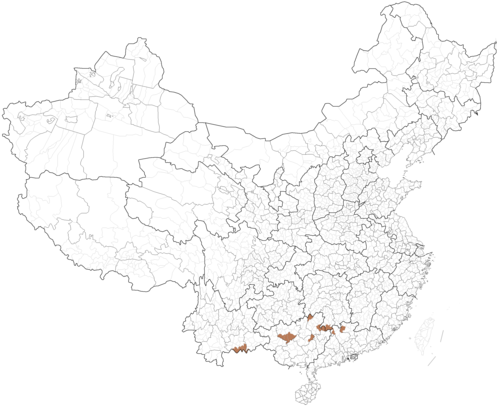
Yao democratic prefectures and counties in China.
Hunan [edit]
Some subgroups of ethnic Yao in Hunan include:[21]
- Pan Yao 盘瑶 (Mian 勉): in Jianghua, Chenxian, Lanshan, Ningyuan, Daoxian, Guiyang, Lingling, Chengbu, Chenxi, Xinning; speak a Mienic linguistic communication.
- Guoshan Yao 过山瑶: in Jianghua, Lanshan, Ningyuan; speak a Mienic language.
- Huajiao Yao 花脚瑶 (Wunai 唔奈): in Longhui, Tongdao, Xupu, Chenxi; speak a Hmongic language.
- Badong Yao 八峒瑶 (Batong Yao 八垌瑶): in Xinning. The Badong Yao speak an endangered Sinitic language. It is spoken in the villages of Huangyandong 黄岩峒, Malindong 麻林峒, and Dazhendong 大圳峒 in Huangjin Ethnic Yao Township 黄金瑶族乡, Xinning County.[22]
- Pingdi Yao 平地瑶 (Bingduoyou 炳多尤): in Jianghua, Jiangyong, and speak a Chinese dialect.
- Qixing Yao 七姓瑶: in Chenxi, and speak a Chinese dialect.
The Hunan Province Gazetteer (1997) gives the following autonyms for various peoples classified past the Chinese government as Yao.
- ju21 mien21 尤棉: in much of Xiangxi Prefecture
- tom21pen21 ju21 董本尤: in Xintian Canton, Yizhang County, Changning County
- ku21goŋ55 ju21 谷岗尤: in Lanshan County, Jianghua County
- thou21 ju21 土尤
- dzau21 min21 藻敏: in Shuangpai County, Dao County, Ningyuan County
- Donglixiao 洞里销: in Xinning County; likewise called Bunu 布努, Donglixiao 峒里俏, or Dong Yao 峒瑶 (Xinning County Gazetteer 2009). Their language is chosen Donghua 峒话.[23] [24] [25]
- mm21 nai33 唔奈: in Longhui Canton, Xupu County
- piŋ21 toa52 jeu21 炳多尤 (also chosen Dainaijiang 代奈江): in Jianghua County, Jiangyong Canton
Tan Xiaoping (2012)[26] also gives the following autonyms for Yao subgroups of Jiangyong County.
- mjəŋ31 勉
- jəu31 mjən31 优勉
- i31 mjəŋ31 壹勉
- iou231 ȵie231 优尼
- piu42tau42 iou42 炳多优
The Yao of Shaoyang Prefecture are found in the post-obit locations (Shaoyang Prefecture Gazetteer 1997). Population statistics are from 1990.
- Xinning County (12,756 Yao persons): Malin 麻林乡, Huangjin 黄金乡, Jingwei 靖位乡 (in Yuanshui 源水瑶族村)
- Dongkou County (8,473 Yao persons): Naxi 𦰡溪乡 (那溪乡), Changtang 长塘乡, Dawu 大屋乡; Yuexi 月溪, Zhaping 渣坪, Tongshan 桐山
- Longhui Canton (half dozen,151 Yao persons): Huxingshan 虎形山乡, Mao'ao 茅坳乡, Xiaoshajiang 小沙江镇, Qingshan 青山, Matangshan 麻塘山
- Chengbu County (two,276 Yao persons): Lanrong 兰蓉, Qingyuan 清源, Dayang 大阳, Tingping 汀坪, Pengdong 蓬洞, Yangmei 杨梅
- Suining Canton (ane,641 Yao persons): Jinta 金趿, Shuikou 水口
The Shaoyang Prefecture Gazetteer (1997) reports that the Yao of Shaoyang Prefecture, Hunan speak the following languages.
- Mienic languages
- Longhui County 隆回: Huxingshan 虎形山, Mao'ao 茅坳, Xiaoshajiang 小沙江
- Dongkou Canton 洞口: Dawu 大屋, Changtang 长塘
- Chengbu County 城步: Qingyuan 清源, Lanrong 兰蓉
- Hmongic languages?: Huangjin 黄金 and Malin 麻林 of Xinning County
- Southern Dong dialect: Naxi 𦰡溪 (那溪), Dongkou County and Lianmin 联民, Suining County
The following population statistics of ethnic Yao in Hunan are from the 1990 Chinese census, as given in the Hunan Province Gazetteer (1997).
| County | Population (1990) |
|---|---|
| Jianghua | 210,944 |
| Jiangyong | 62,647 |
| Dao | 26,771 |
| Ningyuan | 16,361 |
| Lanshan | 16,123 |
| Shuangpai | seven,206 |
| Xintian | 6,295 |
| Qiyang | 3,209 |
| Chenxi | 26,132 |
| Xupu | 13,989 |
| Qianyang | iii,264 |
| Huaihua | 2,066 |
| Tongdao | 1,657 |
| Xinning | 12,756 |
| Dongkou | 8,473 |
| Longhui | 6,151 |
| Chenzhou | v,872 |
| Yizhang | iv,145 |
| Zixing | 3,999 |
| Guiyang | two,323 |
| Changning | 1,085 |
| Full | 460,667 |
By county [edit]
- County-level distribution of the Yao 2000 census
(Merely counties or canton equivalents with more than.1% of canton population are shown.)
| County/Urban center | Yao % | Yao | Total |
| Hu'nan province | one.11 | 704,564 | 63,274,173 |
| Dongkou county | 1,55 | 11,639 | 752,581 |
| Xinning canton | 2,59 | 14,438 | 557,120 |
| Chenzhou city | i,63 | seventy,513 | 4,324,812 |
| Beihu district | ane,25 | three,921 | 314,477 |
| Rucheng county | 15,45 | 52,955 | 342,861 |
| Zixing city | 1,22 | 4,284 | 351,581 |
| Yongzhou city | nine,57 | 513,831 | 5,367,106 |
| Shuangpai county | 4,90 | 7,916 | 161,510 |
| Dao county | 5,92 | 36,938 | 624,199 |
| Jiangyong county | 62,39 | 147,164 | 235,893 |
| Ningyuan county | 2,16 | 15,943 | 738,259 |
| Lanshan county | 5,29 | 17,608 | 332937 |
| Xintian county | 1,82 | vi,541 | 358831 |
| Jihua Yao autonomous county | 61,87 | 270,889 | 437835 |
| Huaihua city | one,55 | 71,952 | 4639738 |
| Zhongfang county | 1,33 | 3,147 | 236675 |
| Chenxi county | 6,77 | 32,405 | 478708 |
| Xupu county | 3,xviii | 25,398 | 798983 |
| Hongjiang city | one,47 | 7,137 | 485061 |
| Guangdong province | 0,24 | 202,667 | 85225007 |
| Shaoguan urban center | one,13 | 31,042 | 2735433 |
| Shixing county | two,00 | four,115 | 205684 |
| Ruyuan Yao autonomous county | ten,75 | 19,121 | 177894 |
| Longmen county | two,51 | 6,726 | 267949 |
| Qingyuan city | iii,05 | 96,043 | 3146713 |
| Lianshan Zhuang Yao autonomous county | 14,33 | 14,195 | 99070 |
| Liannan Yao democratic county | 52,29 | 69,968 | 133814 |
| Lianzhou city | 1,31 | 5,366 | 409360 |
| Guangxi Zhuang autonomous region | 3,36 | 1,471,946 | 43854538 |
| Xincheng district | 1,thirty | five,560 | 426346 |
| Chengbei district | i,l | 5,901 | 392726 |
| Shijiao district | 1,xv | ii,949 | 256730 |
| Guilin city | 8,15 | 375,902 | 4614670 |
| Xiufeng district | one,63 | 2,050 | 125924 |
| Diecai district | i,72 | 2,312 | 134401 |
| Xiangshan district | 1,42 | three,527 | 249135 |
| Qixing district | 1,76 | 4,003 | 227278 |
| Lingui county | 3,53 | 14,957 | 424182 |
| Lingchuan county | 3,twenty | 10,169 | 318036 |
| Quanzhou county | four,29 | 27,984 | 652963 |
| Xing'an canton | 2,35 | 8,317 | 353920 |
| Yongfu county | 3,48 | 8,202 | 235368 |
| Guanyang county | 7,77 | 17,971 | 231288 |
| Longshenggezu autonomous canton | 17,56 | 28,237 | 160796 |
| Ziyuan county | 3,19 | 5,014 | 156946 |
| Pingle county | 14,08 | 55,553 | 394575 |
| Lipu county | 7,48 | 25,893 | 346169 |
| Gongcheng Yao autonomous county | 58,60 | 158,937 | 271216 |
| Wuzhou city | 1,xv | 32,021 | 2796087 |
| Mengshan county | 12,02 | 22,587 | 187918 |
| Fangchenggang city | iv,63 | 34,074 | 735952 |
| Gangkou district | 1,37 | 1,462 | 106403 |
| Fangcheng district | 6,59 | 20,840 | 316111 |
| Shangsi canton | 4,22 | 8,666 | 205307 |
| Dongxing urban center | 2,87 | three,106 | 108131 |
| Guigang urban center | 1,86 | 71,063 | 3827945 |
| Pingnan county | 6,29 | 66,391 | 1055782 |
| Nanning prefecture | one,43 | 68,975 | 4839536 |
| Shanglin county | 6,50 | 24,697 | 379986 |
| Mashan county | 8,48 | 33,873 | 399439 |
| Liuzhou prefecture | 3,57 | 125,839 | 3522322 |
| Heshan metropolis | one,87 | 2,452 | 131,249 |
| Luzhai county | two,01 | 8,424 | 418665 |
| Laibin county | ane,25 | 10,475 | 839790 |
| Rong'an county | ane,88 | 5,313 | 283029 |
| Sanjiang Dong democratic county | iii,88 | 11,798 | 304,149 |
| Rongshui Miao autonomous county | 6,48 | 27,560 | 425,608 |
| Jinxiu Yao autonomous county | 37,45 | fifty,532 | 134,934 |
| Xincheng county | ii,05 | 7,051 | 343,556 |
| Hezhou prefecture | 12,49 | 241,822 | 1,936,849 |
| Hezhou urban center | 4,84 | 41,130 | 850,023 |
| Zhaoping county | 4,46 | 15,746 | 353,298 |
| Zhongshan county | 8,75 | 40241 | 460021 |
| Fuchuan Yao democratic county | 52,91 | 144,705 | 273,507 |
| Baise prefecture | 3,82 | 127,351 | 3,332,096 |
| Baise city | 3,29 | 11,211 | 340,483 |
| Tiandong canton | 4,63 | 16,674 | 360,123 |
| Pingguo county | 4,xvi | 16,344 | 392,800 |
| Debao county | 1,84 | 5,085 | 276,335 |
| Napo county | ii,74 | 4,661 | 170,158 |
| Lingyun canton | 21,05 | 36,954 | 175,573 |
| Leye county | 1,97 | 2,857 | 144,816 |
| Tianlin county | 11,64 | 27,559 | 236,799 |
| Xilin county | 3,54 | 4,934 | 139,282 |
| Hechi prefecture | 9,93 | 349,819 | 3,523,693 |
| Hechi metropolis | two,31 | seven,355 | 318,348 |
| Yizhou city | 5,54 | 30,436 | 549,434 |
| Luocheng Mulao autonomous county | 1,21 | 3,903 | 322,116 |
| Huanjiang Maonan democratic county | 5,36 | 17,807 | 332,067 |
| Nandan county | ix,eighteen | 29,284 | 318,844 |
| Tian'due east county | ii,44 | 3,461 | 141,649 |
| Fengshan county | seven,71 | 12,714 | 164,807 |
| Donglan county | 4,29 | 10,581 | 246,715 |
| Bama Yao autonomous county | 17,24 | 37,706 | 218,724 |
| Du'an Yao autonomous county | 21,66 | 117,609 | 543,019 |
| Dahua Yao democratic county | 21,46 | 78,963 | 367,970 |
| Guizhou province | 0,xiii | 44,392 | 35,247,695 |
| Liping county | 1,10 | five,046 | 458,533 |
| Rongjiang county | one,70 | 5,101 | 300,369 |
| Congjiang county | ii,04 | 6,158 | 301,513 |
| Majiang county | iii,35 | 6,807 | 203,481 |
| Libo county | 3,45 | 5,915 | 171,366 |
| Yunnan province | 0,45 | 190,610 | 42,360,089 |
| Honghe Hani Yi democratic prefecture | 1,86 | 76,947 | 4,130,463 |
| Yuanyang county | 2,eighteen | seven,922 | 362,950 |
| Jinping Miao Yao Dai autonomous county | 12,00 | 37,937 | 316,171 |
| Lüchun county | 3,46 | 6,968 | 201,256 |
| Hekou Yao autonomous county | 22,ten | 21,097 | 95,451 |
| Wenshan Zhuang Miao autonomous prefecture | 2,50 | 81,774 | 3,268,553 |
| Malipo county | 7,06 | 18,926 | 267,986 |
| Guangnan county | 2,16 | 15,781 | 730,376 |
| Funing county | ten,35 | 39,646 | 382,913 |
| Jingdong Yi autonomous county | i,15 | 4,063 | 352,089 |
| Jiangcheng Hani Yi autonomous county | 3,94 | iii,946 | 100,243 |
| Xishuangbanna Dai autonomous prefecture | 1,88 | xviii,679 | 993,397 |
| Mengla county | 6,77 | 15,944 | 235,657 |
Written languages [edit]
After 1982, the Guangxi Nationality Institute and the Chinese Academy of Social Sciences together created a new Yao writing system which was unified with the research results of the Yao-American scholar Yuēsè Hòu (Traditional Chinese: 約瑟·候/Simplified Chinese: 约瑟·候). The writing system was finalized in 1984 in Ruyuan Canton( Chinese characters: 乳源瑤族自治縣), Guangdong, which included Chinese professors Pan Chengqian (盤承乾/盘承乾), Deng Fanggui (鄧方貴/邓方贵), Liu Baoyuan (劉保元/刘保元), Su Defu (蘇德富/苏德富) and Yauz Mengh Borngh; Chinese government officials; Mien Americans Sengfo Chao (Zhao Fuming), Kao Chiem Chao (Zhao Youcai), and Chua Meng Chao; David T. Lee.
American linguist Herbert C. Purnell developed a curriculum and workshop presentations on language learning in Eastward and Southeast Asia, besides as Yao Seng Deng from Thailand. The Usa delegation took the new writing system to the Iu Mien community in the United states where it was adopted with a vote of 78 to 7 by a conference of Mien American community leaders.[vi] This writing arrangement based on the Latin alphabet was designed to exist pan-dialectal; it distinguishes 30 syllable initials, 121 syllable finals and eight tones.
For an example of how the unified alphabet is used to write Iu Mien, a mutual Yao language, see Iu Mien linguistic communication.
At that place is a separate written standard for Bunu, since it is from the Hmong/Miao side, rather than the Mien/Yao side, of the Miao–Yao language family.
Some people think that a variety of Yao is, or was, written in Nüshu, an ethnic script in Southern part of Hunan Province in China. Only this connection between Yao linguistic communication and Nüshu is disputed, considering Nüshu more likely recorded local Chinese dialect which might be likewise known by Yao people in Hunan.
Officially illiteracy and semi-literacy amidst the Yao in China still stood at twoscore.6% in 2002.[27]
Run across also [edit]
- Dance of the Yao people
- Panhu
References [edit]
-
 This article incorporates text from The Chinese times, Volume iv, a publication from 1890, now in the public domain in the United States.
- ^ a b Census 01/04/2019. p. 44. General Directorate for Statistics of Vietnam, nineteen/12/2019. accessdate i/09/2020.
- ^ Wiens, Herold Jacob (1967). Han Chinese expansion in S China . Shoe Cord Printing. p. 276.
- ^ The Chinese times, Volume 4. TIENTSIN: THE TIENTSIN PRINTING CO. 1890. p. 24.
- ^ "Independent Lens . DEATH OF A SHAMAN . The Mien - PBS". www.pbs.org. Archived from the original on 14 Feb 2018. Retrieved three May 2018.
- ^ a b "Yao" in Ethnohistorical Lexicon of Mainland china (ed. James Stuart Olson: Greenwood Printing, 1998), p. 374.
- ^ Sean Marsh, Regal Red china and Its Southern Neighbours ( eds. Victor H. Mair & Liam Kelley: Institute of Southeast Asian Studies, 2015), p. 96.
- ^ Liming Wei, Chinese Festivals (Cambridge University Press, 2011), pp. 106-07.
- ^ Deborah A. Sommer, "Taoism and the Arts" in The Oxford Handbook of Organized religion and the Arts (ed. Frank Burch Brown: Oxford Academy Printing, 2014), p. 384.
- ^ a b Litzinger, Ralph A. (2000). Other Chinas: The Yao and the Politics of National Belonging. Duke Academy Printing. pp. 289–ninety. ISBN0-8223-2549-7.
- ^ "Kim Mun". ethnologue.com. Archived from the original on 3 February 2013. Retrieved three May 2018.
- ^ 毛宗武 / Mao Zongwu. 2004. 瑤族勉语方言研究 / Yao zu Mian yu fang yan yan jiu [A Study of Mien Dialects]. Beijing: 民族出版社 / Min zu chu ban she.
- ^ "江华瑶族自治县的汉语方言和民族语言分布,欢迎补充!!!【江华县吧】_百度贴吧". Archived from the original on 2017-03-14. Retrieved 2017-03-13 .
- ^ Chen, Qiguang [陈其光] (2013). Miao and Yao language [苗瑶语文]. Beijing: Prc Minzu University Press.
- ^ "Archived copy". Archived from the original on 2013-12-30. Retrieved 2013-12-30 .
{{cite web}}: CS1 maint: archived copy equally title (link) - ^ "Archived copy". Archived from the original on 2013-12-30. Retrieved 2013-12-30 .
{{cite web}}: CS1 maint: archived copy as title (link) - ^ Doling, Tim. 2010. Mountains and Ethnic Minorities: North West Việt Nam. Thế Giới Publishers.
- ^ Chảo Văn Lâm. 2013. Thơ ca hôn lễ: người Dao Đỏ ở Lào Cai. Hà Nội: Nhà xuất bản văn hóa thông tin.
- ^ a b Nguyễn Mạnh Hùng. 2013. Lễ cưới người Dao Nga Hoàng. Hà Nội: Nhà xuất bản văn hóa thông tin.
- ^ PGS. TS. Nguyễn Khắc Tụng, TS. Nguyễn Anh Cường. 2004. Trang phục cổ truyền của người Dao ở Việt Nam. Hà Nội: Nhà xuất bản khoa học xã hội [viện khoa học xã hội Việt Nam].
- ^ a b Guizhou Province Gazetteer: Ethnic Gazetteer [贵州省志. 民族志] (2002). Guiyang: Guizhou Ethnic Publishing Firm [貴州民族出版社].
- ^ 湖南瑶族社会历史调查 (2009)
- ^ Lei Biying; Zheng Linguang [雷碧英; 郑林光; 新宁县民族宗教事务局; 新宁县黄金瑶族乡中心学校]. 2012. Badong Yao language [八峒瑶语]. Xinning: Xinning County Indigenous and Religious Affairs Bureau [新宁县民族宗教事务局].
- ^ 道客巴巴 (7 June 2012). "新宁县瑶族乡濒危方言峒话调查". www.doc88.com. Archived from the original on 3 May 2018. Retrieved 3 May 2018.
- ^ 吴萍 (3 May 2018). "湖南新宁瑶族"峒话"音系". 现代语文:下旬.语言研究 (10). Archived from the original on 31 July 2013. Retrieved 3 May 2018.
- ^ 许阳; 胡萍 (3 May 2018). "新宁县瑶族乡峒话的语音系统". 文教资料 (32). Archived from the original on 30 July 2013. Retrieved 3 May 2018.
- ^ Tan Xiaoping [谭晓平]. 2012. Linguistic communication contact and development: the Mien language of the Yao people of Jiangyong Canton, southern Hunan [语言接触与语言演变: 湘南瑶族江永勉语个案研究. Wuhan: Central Red china Normal University Press [华中师范大学出版社]. ISBN 978-7-5622-5409-6
- ^ "您访问的页面丢失了 - 中国红河网 - 官方网站". www.hh.cn. Archived from the original on 3 March 2016. Retrieved three May 2018.
Sources [edit]
- AsiaHarvest.org: Indigenous grouping profiles of China
- Forbes, Andrew, and Henley, David, 'Chiang Mai's Colina Peoples' in: Ancient Chiang Mai Volume three. Chiang Mai, Cognoscenti Books, 2012. ASIN: B006IN1RNW
- Máo Zōngwǔ 毛宗武: Yáozú Miǎnyǔ fāngyán yánjiū 瑶族勉语方言研究 (Studies in Mien dialects of the Miao nationality; Běijīng 北京, Mínzú chūbǎnshè 民族出版社 2004), ISBN 7-105-06669-v.
- Méng Cháojí 蒙朝吉: Hàn-Yáo cídiǎn - Bùnǔyǔ 汉瑶词典——布努语 (Chinese-Yao Dictionary - Bunu; Chéngdū 成都, Sìchuān mínzú chūbǎnshè 四川民族出版社 1996), ISBN 7-5409-1745-8.
- Barker, Judith C., and Saechao, Kaochoy. "A Household Survey of Older Iu-Mien Refugees in Rural California." Journal of Cross-Cultural Gerontology 12.two (1997): 121-143.
- Barker, Judith C. & Saechao, Kaochoy. (2000). A demographic survey of Iu-Mien in West Coast States of the U.South., 1993. Journal of Immigrant Health, 2:i, 31-42.
- Phan Ngọc Khuê. 2003. Lễ cấp sắc của người Dao Lô Gang ở Lạng Sơn. Hà Nội: Nhà xuất bản văn hóa thông can.
Films [edit]
- 2003 - Expiry of a Shaman. Directed by Richard Hall; produced by Fahm Fong Saeyang.
- 1989 - "Moving Mountains: The Story of the Yiu Mien". Directed and produced by Elaine Velazquez
External links [edit]
 | Wikimedia Eatables has media related to Yao people. |
- The Virtual Hilltribe Museum
- The Yao ethnic minority (on a Chinese government website)
- Yao religious culture - bibliography past Barend ter Haar
- Yao People On-line - in Chinese
- The Mien
- The Yao of Thailand
- LearnMien.com
Source: https://en.wikipedia.org/wiki/Yao_people
0 Response to "Art of the Yao People Government of the Yao People"
Post a Comment